

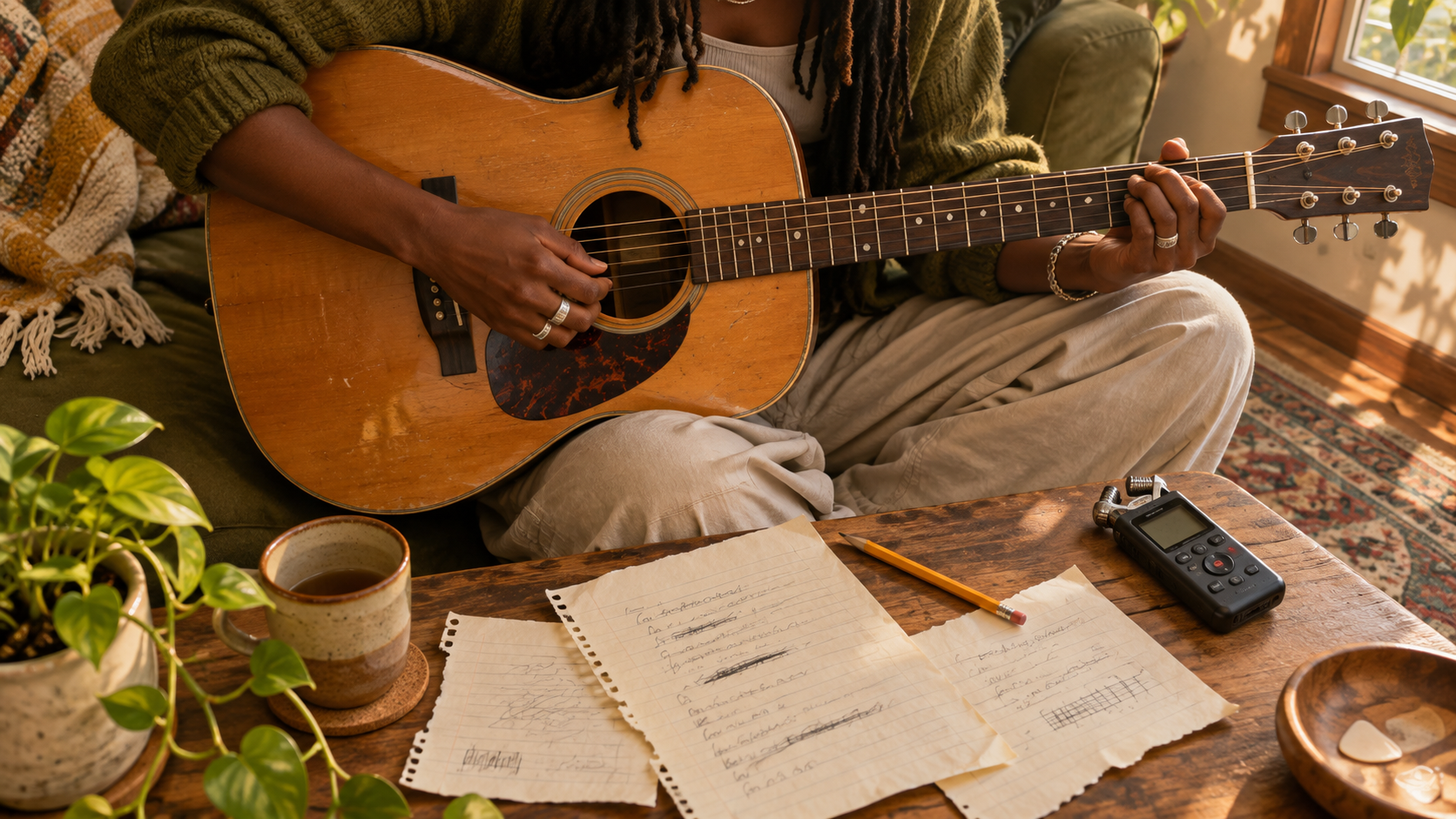
Give yourself five short sketches to listen back to.
Use the instrument you already play, one rule per sketch, and a recording you can finish in a sitting.
You’ve got half a chorus in your voice memos, a guitar part you love, and a project called New Song 12 that hasn’t been opened since August. Then somebody asks what your music sounds like, and suddenly you need three genres and a paragraph to answer.
If you’re wondering how to find your sound as an artist, give yourself something concrete to listen to. Finish five short sketches, each with one rule. Then compare them. You might hear yourself coming back to the same type of harmony, the same guitar rhythm, or that plainspoken line you almost edited out.
1. Give yourself something to listen back to
A half-written chorus tells you what caught your ear. A sketch with a beginning, a change, and an ending tells you what you do with that idea. Do you bring in a harmony at the last minute? Drop the guitar for the line you want people to hear? Let the last chord hang?
Those choices are part of your sound. Make five small recordings so you have enough material to hear which decisions keep coming back.
2. Borrow a technique from the music you love
Pick three songs you return to and name one thing you love about each. Get specific. Maybe the singer delivers the verse almost like a conversation. Maybe the snare comes in late. Maybe the guitar leaves a gap for the vocal to answer.
Take one of those techniques into an original sketch. If you love the way a singer lets a line trail off, write your own line and try leaving that same kind of space after it. Keep your own lyrics and melody. You can hear what the technique does for you without having to recreate the whole record.

3. Make five sketches with one rule each
Give each sketch about 20 minutes and aim for 45–90 seconds. Use the phone recorder or recording software you already have. If an experiment gets you excited, save the bigger ideas for another session and finish the small version first.
- One instrument. Use guitar or keys as the only accompaniment. Hear how you fill the space with your voice and playing.
- One tempo. Choose a tempo before you write and keep it for the whole sketch. Try changing how your words sit against the beat whenever a line feels crowded.
- One lyrical rule. Set the whole lyric in one room. Use details a listener could see or hear there, like keys on the counter or a phone buzzing after midnight.
- One chord progression. Keep the same chords from beginning to end. Use a new melody, a lighter touch, or a different vocal rhythm to make the chorus feel like it arrived.
- One harmony entrance. Keep the lead alone until the final line. Listen to how that one entrance changes the weight of the words.
4. Finish the sketch while it’s still rough
For this exercise, finished means you can press play and hear a complete little idea. Try four bars to establish the mood, four bars where something changes, and a clear ending. One take with a string squeak still counts if you can hear what you were going for.
Give each recording a name you’ll understand later, such as 01 – Guitar Only or 05 – Last-Line Harmony. Export it or save a voice memo. Write one sentence about what surprised you, then move to the next sketch.
5. Listen for what keeps repeating
Give your ears a break. The next day, play all five sketches at roughly the same volume. Put the project windows away so you can listen without reaching for a knob.

Write down the moments you want to replay. Where did your voice feel most natural? Which rhythm kept them moving? What lyric could you still remember after the next sketch started? Look for choices that show up even when the rules change.
Say three sketches have a quiet vocal, a guitar part that answers the singer, and a harmony saved for the last line. That gives you a specific combination to try again. See how it feels in a different key or with a lyric about something completely different.
6. Ask two or three people what caught their ear
Send the same sketches to a few people who will listen closely. Give each person the same questions, and let them answer before you tell them your favorite.
I’m trying a few different ideas for my next song. Which moment made you want to hear more? Was there a line, sound, or melody you remembered afterward? A timestamp would help.
“I liked sketch three” is a start. “I replayed the part at 0:34 when the guitar dropped out” gives you something you can use. If several people point to that same moment and you love it too, try leaving space like that in your next song.
7. Try three changes with the gear you already have
Before you shop for a different sound, replay your favorite sketch and change one thing at a time. Try a closer vocal in a quieter spot, a softer guitar attack, or a version with one fewer layer. Save a short recording of each version and compare them at similar playback volumes.
If the vocal feels more intimate when you sing softly and leave the guitar part sparse, you’ve learned something you can use in every session. If the same problem keeps showing up, name it before spending. “I need two mic inputs to record guitar and voice together” is a purchase you can evaluate. “I need to sound more like me” is another reason to make a sketch.
8. Turn what you hear into a writing habit
Once a week, make one new sketch that repeats a choice you loved and tests one new idea. For example, keep the conversational vocal and try a brighter chord progression. When an idea holds your attention after a few listens, pick it for a full arrangement and give it a separate session.
Keep a short note in your project folder with the choices you want to try again. Update it when a new song teaches you something. Over time, those notes give you a way back into a session when you sit down and have no idea where to start.
Share the first sketch
Pick one rule tonight and record a minute. Share it in the comments if they’re open, or in your songwriting community. Tell people the rule you used and ask them to point to the moment they’d keep.
When a sketch starts turning into a release, use the budget guide to decide what’s worth paying for.